
Plan Your Hokkaido Journey · Itinerary framework
How Many Days Do You Need in Hokkaido? A Practical Itinerary Framework
From a short Sapporo escape to a seven-day cross-region journey, choose a length that leaves room for the road, the season, and your own pace.
The right length is not the longest trip. It is the length that lets your route breathe.
For most first-time visitors, five days is the sweet spot. It gives you enough time to arrive well, enjoy Sapporo, see at least one distinct landscape, and include an overnight experience without turning every day into a transfer.
But the best answer depends on how you define Hokkaido. If you mean a compact city-and-coast chapter, three days can be excellent. If you hope to pair Sapporo with Furano, Biei, an onsen town, or southern Hakodate, give yourself at least five days. Seven or more days lets the island open up across two or three connected regions.
The mistake is not choosing a short trip. It is treating a large island as if every appealing place belongs in the same day. The aim of this framework is to help you pick a shape that feels complete rather than crowded.
Use a simple test before adding a new stop: can you arrive before the experience has closed, enjoy it without watching the clock, and still reach your overnight location before the day feels like a transfer? If not, make that place the purpose of a later trip rather than squeezing it into this one.
Calendar days and usable sightseeing days are not the same. An arrival day includes collecting luggage, choosing a meal, checking in, and recovering from a flight. A departure day includes packing, breakfast, the hotel handoff, and the airport transfer. Treating both as full touring days is one of the quickest ways to make an otherwise sensible Hokkaido itinerary feel hurried.
Hotel changes deserve the same honesty. A new hotel may create a wonderful evening, but it also includes check-out, luggage, travel, check-in, and learning a new neighbourhood or facility. Make the change only when it improves the next morning, gives you a meaningful dinner-and-onsen chapter, or removes a long return drive. If it does none of these things, another night at the existing base often creates a stronger trip.
Priorities should be ranked, not simply listed. Choose one “must feel complete” experience, two supporting experiences, and several optional stops. The must experience may be a full Furano and Biei day, a Hakodate evening, a Niseko snow chapter, or a lake-and-onsen overnight. Supporting experiences can be fitted around it. Optional stops are where the route can flex for weather, food, or energy.
This ranking helps on the road. If weather closes in, you can protect the must experience by changing the order of the day. If lunch runs longer than expected, you can drop an optional stop without feeling that the itinerary failed. A private driver is particularly useful for this kind of plan because the route can respond to the group and conditions while retaining a clear overall shape.
Choose by what you want the trip to feel like.
A focused introduction
Sapporo plus one carefully chosen day trip. Best for a short stop or a first taste.
A compact contrast
A city base plus coast, onsen, or a second landscape without too many hotel changes.
A balanced first visit
Sapporo and an additional regional chapter, with enough margin for food, weather, and rest.
A deeper journey
Two or three connected regions, slower overnights, and a route that can follow the season.
Arrival and departure days are often lighter than they look. New Chitose Airport connects to Sapporo by train in as little as 33 minutes, while the fastest service to Otaru takes around 73 minutes.[1] Add baggage collection, hotel check-in, meal stops, and the energy level of your group before calling either day a full sightseeing day.
Start with the airport, not the postcard. New Chitose is a natural gateway for a Sapporo, Otaru, Furano and Biei, or Noboribetsu route. Hakodate or Asahikawa can create a more focused southern or central/northern trip. Once the start and end points are fixed, the right number of nights becomes much easier to see.
Protect the first evening and the final morning. Those two small decisions make the whole itinerary feel calmer.
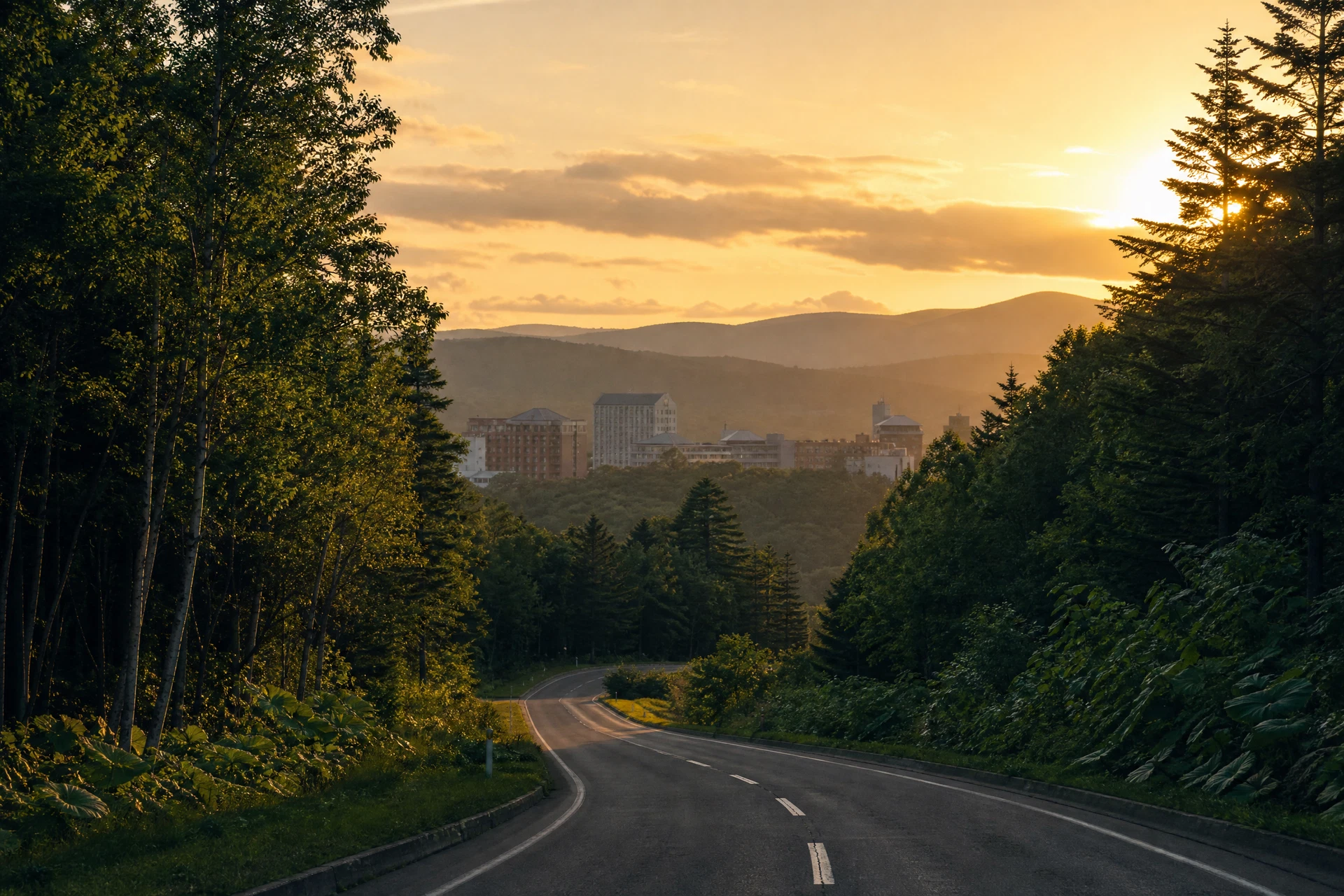
What each length of stay can do well.
These are route frameworks rather than promises. Exact timing changes with your season, hotel location, arrival flight, group, and interests.
3 days · Sapporo and one standout day
Choose a Sapporo base. Give one day to the city and food culture, then take one full day for Otaru, a nearby onsen, or a focused countryside route. This is the right answer when you prefer one hotel and an easy rhythm.
Suggested shape: New Chitose → Sapporo · Sapporo → Otaru → Sapporo · departure
4 days · A city plus a second mood
Add one overnight or a second full excursion. You might pair Sapporo with Otaru and a scenic coastal drive, or stay one night in an onsen town. Four days works when you want contrast without a large cross-island transfer.
Suggested shape: arrival in Sapporo · Sapporo city · Otaru/coast · onsen or final city morning
5 days · The best all-round first trip
Use five days to include a city, an open-road day, and an overnight landscape. Summer can point you toward Furano and Biei; winter may point you to Niseko or a hot-spring stay. The extra night gives your route permission to slow down.
Suggested shape: Sapporo · Otaru · Furano/Biei or onsen overnight · scenic return · departure
7+ days · Two or three connected regions
A week can support a richer line through Sapporo, central scenery, onsen country, and the south—or an entirely different eastward route. JNTO’s overview of Hokkaido’s cities, ski areas, hot springs, food, national parks, and culture is a useful reminder of just how many distinct chapters the island holds.[2]
Suggested shape: choose a regional corridor, add no more than two or three hotel changes, and leave at least one flexible half-day.
Choose three nights when you want one hotel, a city-led arrival, and a single standout day. Choose four nights when you want either a second excursion or one restful overnight outside the city. Choose five nights when you want a city, a meaningful road day, and an onsen, lake, rural, or resort chapter without asking every day to become a transfer.
With a week, choose a corridor rather than a collection of detached attractions. A south-to-central journey can begin in Hakodate and move through lake or onsen country toward Sapporo. A Sapporo-led journey can place a countryside or resort chapter in the middle and leave the final night close to the airport. The best itinerary uses extra nights to improve the quality of mornings and evenings, not simply to add mileage.
Before adding a place, apply the arrival test: can you reach it before the experience has closed, enjoy it without watching the clock, and still arrive at your hotel with enough energy for dinner? If not, preserve it for a future journey. Hokkaido rewards visitors who make fewer places feel complete.
Fix the elements that are genuinely time-sensitive: flights, the first and final hotel, a special accommodation, or a reservation that matters to the group. Keep the road-side details flexible: which viewpoint, which lunch stop, whether to take a short walk, or whether to arrive at the onsen earlier. This gives the itinerary structure without making it brittle.
In summer, the flexible hours are useful for longer daylight and farm or landscape detours. In autumn, they can follow the best colour and weather window. In winter, they protect against slower roads and invite a calmer city, resort, or onsen day. In spring, they make room for shifting blossom timing and quieter routes. The right number of nights is partly the number that gives your chosen season space to work.
Ask each travel companion to choose one must-do and one nice-to-have before finalising the route. When priorities conflict, use the must-dos to decide the regional corridor and use the nice-to-haves as optional additions. This avoids the familiar problem of having six people’s wishes squeezed into one day, while still giving everyone a moment that feels included.
For a private-driver day, share both the fixed plan and the flexible plan. The driver can then help choose the order of stops based on the conditions, group energy, meal timing, and how the road is unfolding. The result is a day with clear purpose but enough room to be enjoyable in real time.
Couples who are happy with one scenic drive and a late dinner may be comfortable with a compact four-night route. Families may need the same route to have five nights so meal timing, naps, child seats, and a slower hotel handoff do not compete with the experience. Multi-generational groups often benefit from an extra night because the value of the trip is not only distance covered, but the time everyone can comfortably spend together.
Photographers, hikers, skiers, and travellers who have come for one seasonal experience should build a weather margin around the key day. If the landscape is the reason for travelling, do not schedule it as the only possible activity between two hard transfers. An additional night can protect the experience, even when the total map distance looks manageable.
Hotel changes should follow the same logic. Use one hotel when it gives a city or regional base enough flexibility. Add an overnight when it gives the group an evening worth arriving for, a better morning, or a meaningful reduction in driving. Avoid changing hotels simply to make the itinerary look varied; a varied route can still be built from road, food, weather, and scenery while returning to the same comfortable base.
A final rule is to leave the last night close enough to your departure that the final morning remains calm. This is particularly helpful in winter, with children, or when a group has multiple suitcases. A trip length is correct when the first night, the key day, and the last transfer all feel achievable without rushing. If the beginning of the route is still undecided, compare Sapporo, New Chitose, and Hakodate as start points before fixing the hotel sequence.
Two simple rules make a Hokkaido itinerary better.
Change hotels with intention
A hotel change should unlock a new atmosphere—a lakeside ryokan, an alpine morning, a southern port—not simply move you a little farther down the road.
Give the driving day a purpose
Connect a transfer with a food stop, a viewpoint, a short walk, or a local craft experience. With a private driver, those transitions can become the most memorable part of the route.
Choose 3–4 nights for one base and one standout day, five nights for one city plus one meaningful overnight landscape, and seven or more nights for a connected corridor. Avoid using an open afternoon to add a distant region; a weather buffer, onsen, or slower meal usually creates a better trip.
A private driver does not mean every day needs to be private. Many visitors combine an independent city stay with one or two charter days for the countryside, an airport-to-onsen transition, or a scenic itinerary that would otherwise involve several connections and luggage decisions.
This can be especially useful when your day includes more than one region, when daylight is limited, when travelling with children, or when you simply want to watch the landscape rather than the navigation. Begin with the places that matter most; we can help identify what fits comfortably into the time you have.
For first-time planning fundamentals, see Hokkaido for First-Time Visitors: A Private Driver’s Planning Guide.
Questions to settle before you set dates.
Is 3 days enough for Hokkaido?
Three days can work for a focused Sapporo-based stay with one carefully chosen day trip. It is not enough to try to cover the entire island, but it can be an excellent first chapter.
Is 5 days enough for a first Hokkaido trip?
Five days is often the most balanced length for a first visit. It allows an arrival buffer, Sapporo, one or two scenic day trips, and a countryside or onsen overnight without rushing every transfer.
How many days do I need to see Sapporo, Otaru, Furano, and Biei?
Plan at least five days if you want to connect these places at a comfortable pace. The exact shape depends on your arrival time, season, and whether you use a private driver, rental car, or trains and buses.
Should I change hotels every night in Hokkaido?
Usually not. Fewer hotel changes give you more usable time and a steadier pace. A good first-trip plan often uses one city base plus one or two carefully chosen overnight stays.
How many days should I allow for winter in Hokkaido?
Add breathing room rather than packing more stops into a day. Winter travel benefits from flexible timing, realistic transfer expectations, and a route that can adapt to conditions.
How many hotel changes are sensible for a five-day Hokkaido trip?
For many first visits, one or two carefully chosen hotel bases are enough. Change hotels only when it creates a meaningful new chapter, such as an onsen stay or an early rural morning.
What is the biggest itinerary mistake in Hokkaido?
Treating arrival days as full sightseeing days and adding distant places simply because they look close on a map. Build around usable hours, not a long attraction list.
Tell us how many nights you have. We will help make them count.
Share your dates, arrival airport, group size, season, and priorities. We will help turn a number of days into a Hokkaido journey with a clear rhythm.